
tinypng.cloud_Gemini_Generated_Image_xahkhvxahkhvxahk

The Perfect Conclusion: End Your Essay the Right Way!

A weak conclusion lowers your score because it makes your essay feel unfinished. Your conclusion should:

  • ✔️ Summarize key points (without repeating word-for-word)
  • ✔️ Give a final thought or recommendation (if needed)
  • ✔️ Be short & clear (2-3 sentences max)

Step 1: Follow the Perfect Conclusion Structure

A Band 7+ conclusion has two key elements:

  1. Summarizing your main points
    • Don’t copy sentences from your body paragraphs!
    • Instead, restate your ideas in a fresh way.
  2. Giving a final thought
    • If the essay asks for your opinion, state it clearly.
    • If it’s a discussion essay, balance both views.

📌 Example Conclusion for a “To What Extent” Essay:

In conclusion, while technology has made life more convenient, it also leads to social isolation. However, I believe the benefits outweigh the drawbacks, as digital tools improve communication, learning, and efficiency.

📌 Example Conclusion for a “Discussion” Essay:

To summarize, some believe that success is based on luck, while others argue that hard work is more important. Both views have merit, but ultimately, consistent effort and determination play the biggest role in achieving success.

Step 2: Common Mistakes to Avoid in Conclusions

  • Don’t start with “In a nutshell” or “To conclude my essay”
  • Use formal phrases like In conclusion, Overall, To summarize
  • Don’t repeat your introduction
  • Restate your ideas using different words
  • Don’t add new ideas
  • Your conclusion should only summarize previous points

Final Takeaway: Keep Your Conclusion Short & Strong!

  • ✔️ Summarize key points in a fresh way
  • ✔️ Give a final thought or opinion
  • ✔️ Keep it clear & concise (2-3 sentences)

Master this, and you’ll leave a great last impression on the examiner! 🚀
tinypng.cloud_Gemini_Generated_Image_muhxc2muhxc2muhx

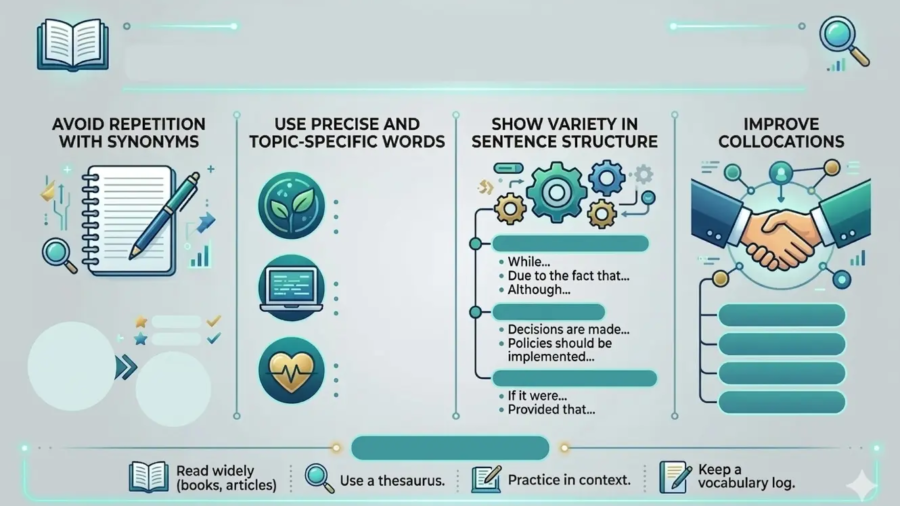
Lexical Resource: Using the Right Vocabulary for a Band 7+ Essay

Vocabulary (Lexical Resource) makes up 25% of your Writing Task 2 score. Avoid these common mistakes:

  • Using complicated words incorrectly
  • Repeating the same words too often
  • Forgetting to use topic-specific vocabulary

Step 1: Use Topic-Specific Vocabulary

To sound natural, use precise words related to the topic.

  • Education: Optimal learning environment instead of good conditions
  • Environment: Environmental degradation instead of pollution is a big problem

Step 2: Use Synonyms (Naturally!)

Instead of repeating the same word, use variations.

  • Important: Essential, Crucial, Vital, Significant
  • Increase: Rise, Surge, Expand, Accelerate

Step 3: Avoid Overusing Basic Words

Replace weak words with stronger alternatives.

  • Very important: Crucial, Essential
  • Very big: Enormous, Significant
  • Very bad: Detrimental, Harmful
  • Very good: Exceptional, Outstanding

Step 4: Avoid Informal Language & Clichés

“Technology is growing like crazy!”
✔️ “Technology is advancing rapidly.”

“Education is good for people.”
✔️ “Education plays a vital role in development.”

Final Takeaway

  • ✔️ Use topic-specific words
  • ✔️ Vary your vocabulary naturally
  • ✔️ Replace weak words with stronger alternatives
  • ✔️ Keep it formal—avoid slang & clichés

Master these tips, and your Lexical Resource score will improve significantly! 🚀

tinypng.cloud_Gemini_Generated_Image_cvgst0cvgst0cvgs

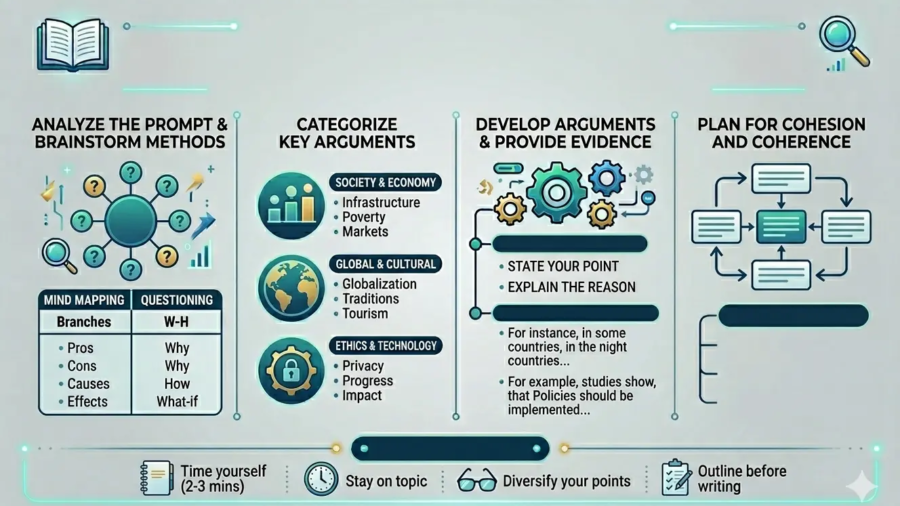
How to Brainstorm Ideas Effectively for IELTS Task 2

Many IELTS students struggle with brainstorming. They either:

  • ❌ Take too long thinking of ideas
  • ❌ Come up with off-topic arguments
  • ❌ Use weak examples that lower their score

Good brainstorming helps you write faster, better, and with more confidence. Here’s how to do it right.

Step 1: Identify the Focus of the Question

🔹 Before brainstorming, break down the keywords in the question.

📌 Example Question:

“Many people believe that online education is the future of learning. To what extent do you agree or disagree?”

🔹 Main Keywords: “online education,” “future of learning”

🔹 Task Type: Opinion essay (agree/disagree)

Step 2: Use Mind Mapping for Clear Organization

A mind map helps you quickly generate and organize ideas.

  • Pros:
    • ✔️ More accessible for students worldwide 🌍
    • ✔️ Cost-effective, no travel needed 🚆
    • ✔️ Flexible learning at any time ⏳
  • Cons:
    • ❌ Lack of personal interaction 🗣️
    • ❌ Not all subjects can be taught online (e.g., medicine) 🏥
    • ❌ Requires self-discipline & internet access 💻

Step 3: Find Strong Examples

A Band 7+ essay needs specific examples, but what if you don’t have real-life knowledge?

  • 🔹 Use general examples that sound realistic.
  • 🔹 Use statistics (even if estimated).
  • 🔹 Use cause-effect reasoning.

Final Checklist for Effective Brainstorming

  • ✅ Have I understood the question fully?
  • ✅ Have I used a mind map to organize my ideas?
  • ✅ Are my examples strong and relevant?

By practicing these steps, brainstorming will become second nature, and you’ll write faster & better in the IELTS exam! 🚀

tinypng.cloud_Gemini_Generated_Image_yfo46xyfo46xyfo4

Beat the Clock: How to Write a High-Scoring Essay in 40 Minutes

Many IELTS students run out of time while writing Task 2. They either:

  • ❌ Spend too long thinking of ideas
  • ❌ Rush through writing and make mistakes
  • ❌ Finish late and skip proofreading

Here’s how to manage your time efficiently and complete a well-structured essay within 40 minutes!

Step 1: Follow the Ideal Time Breakdown

  • 1-2 minutes: Analyzing the question
  • 📝 5-7 minutes: Brainstorming & Planning
  • ✍️ 25-30 minutes: Writing the essay
  • 🔍 5 minutes: Reviewing & Correcting Mistakes

💡 Pro Tip: If you spend too long brainstorming, you’ll rush your essay. Stick to your time limits!

Step 2: The Power of Quick Planning

Some students skip planning to “save time”—but this is a mistake! A simple plan helps you:

  • ✔️ Avoid getting stuck mid-way
  • ✔️ Write faster with clear ideas
  • ✔️ Ensure a balanced argument

📌 Example Quick Plan:

Question: “Some people think technology makes life more complex. Others believe it simplifies our lives. Discuss both views and give your opinion.”

  • Body Paragraph 1 (More Complex):
    • People now depend too much on technology
    • Social media = stress & distractions
    • Example: Many professionals work 24/7 due to emails
  • Body Paragraph 2 (Simplifies Life):
    • Easier communication (video calls, instant messages)
    • Online shopping & banking save time
    • Example: AI helps automate tasks in businesses
  • Conclusion: Tech has both pros & cons, but benefits outweigh negatives

💡 Planning takes only 5-7 minutes but helps you write FASTER!

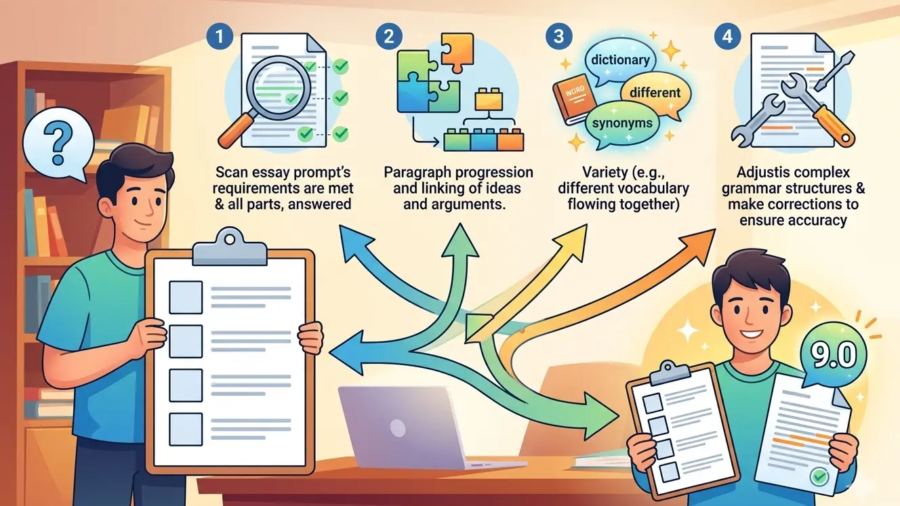
Step 3: Reviewing Your Essay in 5 Minutes

The final 5 minutes should be spent on checking and fixing mistakes.

🔍 What to Check?

  • ✅ Grammar & Spelling – Any errors in verbs, articles, punctuation?
  • ✅ Coherence & Cohesion – Are sentences logically connected?
  • ✅ Word Count – Do you have at least 250 words?

💡 Trick: Read your essay backward (sentence by sentence) to spot errors easily!

Final Takeaway: Stick to the 40-Minute Strategy!

  1. Analyze the question (2 min) – Identify keywords & task type
  2. Plan ideas (5-7 min) – Outline your main points
  3. Write efficiently (25-30 min) – Follow the 4-paragraph structure
  4. Review (5 min) – Fix errors & improve clarity

Mastering time management is the key to finishing strong in IELTS Writing! 🚀

tinypng.cloud_Gemini_Generated_Image_yssb5hyssb5hyssb

Common Grammar Mistakes That Lower Your IELTS Band Score (And How to Fix Them!)

Grammar makes up 25% of your IELTS Writing Task 2 score, and even small errors can drag your score down. Many test-takers lose marks not because their ideas are weak, but because of grammar mistakes that affect clarity and coherence.

1. Incorrect Verb Tenses

Many students mix up verb tenses, making their essays confusing or inconsistent.

  • Wrong: People in the past was healthier than now.
  • Correct: People in the past were healthier than they are now.

📌 Quick Tip: In IELTS Task 2, you will mostly use the present simple (for facts) and present perfect (for trends).

2. Article Errors (a/an/the)

  • Wrong: Government should invest in education.
  • Correct: The government should invest in education.

📌 Use “the” for specifics and “a/an” for general references.

3. Subject-Verb Agreement Errors

  • Wrong: Many people prefers online learning.
  • Correct: Many people prefer online learning.

📌 Be careful with words like everyone, each, every—they take singular verbs.

4. Preposition Mistakes

  • Wrong: People should focus in their careers.
  • Correct: People should focus on their careers.

📌 Learn common preposition + noun/verb patterns.

5. Run-on Sentences & Comma Splices

  • Wrong: Technology is advancing rapidly, people are becoming dependent on it.
  • Correct: Technology is advancing rapidly, and people are becoming dependent on it.

📌 Break long sentences and use proper linking words.

6. Lack of Sentence Variety

  • Wrong: Technology is important. It helps people. It makes life easier.
  • Correct: Technology is important because it helps people and makes life easier.

📌 Use relative clauses and complex sentences for variety.

Final Takeaways: How to Avoid These Grammar Mistakes!

  • ✅ Always check verb tense consistency.
  • ✅ Use articles (a/an/the) correctly.
  • ✅ Make sure subjects and verbs agree.
  • ✅ Use the right prepositions.
  • ✅ Break long sentences for better clarity.
  • ✅ Mix sentence structures to sound more natural.

By improving these areas, you’ll boost your accuracy and increase your IELTS Writing score! 🚀

tinypng.cloud_Gemini_Generated_Image_f93gnxf93gnxf93g

How to Analyze an IELTS Writing Task 2 Question Like a Pro

One of the biggest mistakes IELTS candidates make is not fully understanding the question before they start writing. Even if your English is strong, answering incorrectly can cost you valuable points in Task Response.

Step 1: Identify the Keywords

Every IELTS Task 2 question contains important keywords that tell you exactly what the essay should focus on.

👉 Sample Question:

Some people believe that children should be given homework every day, while others think it is unnecessary. Discuss both views and give your own opinion.

  • Main Keywords: “children,” “homework every day,” “unnecessary”
  • Action Words: “Discuss both views” + “Give your own opinion”

✅ The question asks you to present both sides of the argument and clearly state your opinion.

💡 Common Mistake: Some students only discuss one view and forget to present both sides.

Step 2: Understand the Task Type

Each IELTS Task 2 question follows a specific format. Recognizing the type of question before writing helps you structure your answer correctly.

  • Opinion Essay (Agree/Disagree) – Do you agree or disagree?
  • Discussion Essay – Discuss both views without giving your opinion.
  • Discussion + Opinion Essay – Discuss both views and give your opinion.
  • Problem/Solution Essay – Explain problems and suggest solutions.

💡 Pro Tip: If the question asks “To what extent do you agree?”, you can partially agree instead of choosing a side completely.

Step 3: Spot Hidden Details

📌 Example Question:

Many people believe that social media negatively affects young people’s mental health. To what extent do you agree?

❌ Weak Approach: Only talking about social media’s impact on everyone (ignoring “young people”).

✅ Correct Approach: Focusing on young people’s mental health and how social media affects them specifically.

Final Checklist Before You Write

  • ✅ Have I identified the main keywords?
  • ✅ Do I understand the question type?
  • ✅ Am I answering exactly what is asked?

Understanding the question is half the battle won in IELTS Task 2. Practice these steps, and you’ll avoid costly mistakes! 🚀