
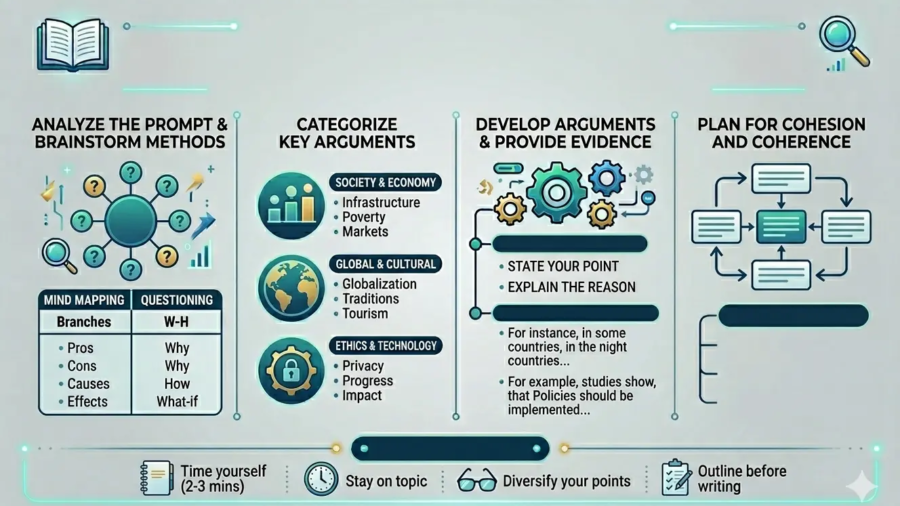
Many IELTS students struggle with brainstorming. They either:
- ❌ Take too long thinking of ideas
- ❌ Come up with off-topic arguments
- ❌ Use weak examples that lower their score
Good brainstorming helps you write faster, better, and with more confidence. Here’s how to do it right.
Step 1: Identify the Focus of the Question
🔹 Before brainstorming, break down the keywords in the question.
📌 Example Question:
“Many people believe that online education is the future of learning. To what extent do you agree or disagree?”
🔹 Main Keywords: “online education,” “future of learning”
🔹 Task Type: Opinion essay (agree/disagree)
Step 2: Use Mind Mapping for Clear Organization
A mind map helps you quickly generate and organize ideas.
- Pros:
- ✔️ More accessible for students worldwide 🌍
- ✔️ Cost-effective, no travel needed 🚆
- ✔️ Flexible learning at any time ⏳
- Cons:
- ❌ Lack of personal interaction 🗣️
- ❌ Not all subjects can be taught online (e.g., medicine) 🏥
- ❌ Requires self-discipline & internet access 💻
Step 3: Find Strong Examples
A Band 7+ essay needs specific examples, but what if you don’t have real-life knowledge?
- 🔹 Use general examples that sound realistic.
- 🔹 Use statistics (even if estimated).
- 🔹 Use cause-effect reasoning.
Final Checklist for Effective Brainstorming
- ✅ Have I understood the question fully?
- ✅ Have I used a mind map to organize my ideas?
- ✅ Are my examples strong and relevant?
By practicing these steps, brainstorming will become second nature, and you’ll write faster & better in the IELTS exam! 🚀